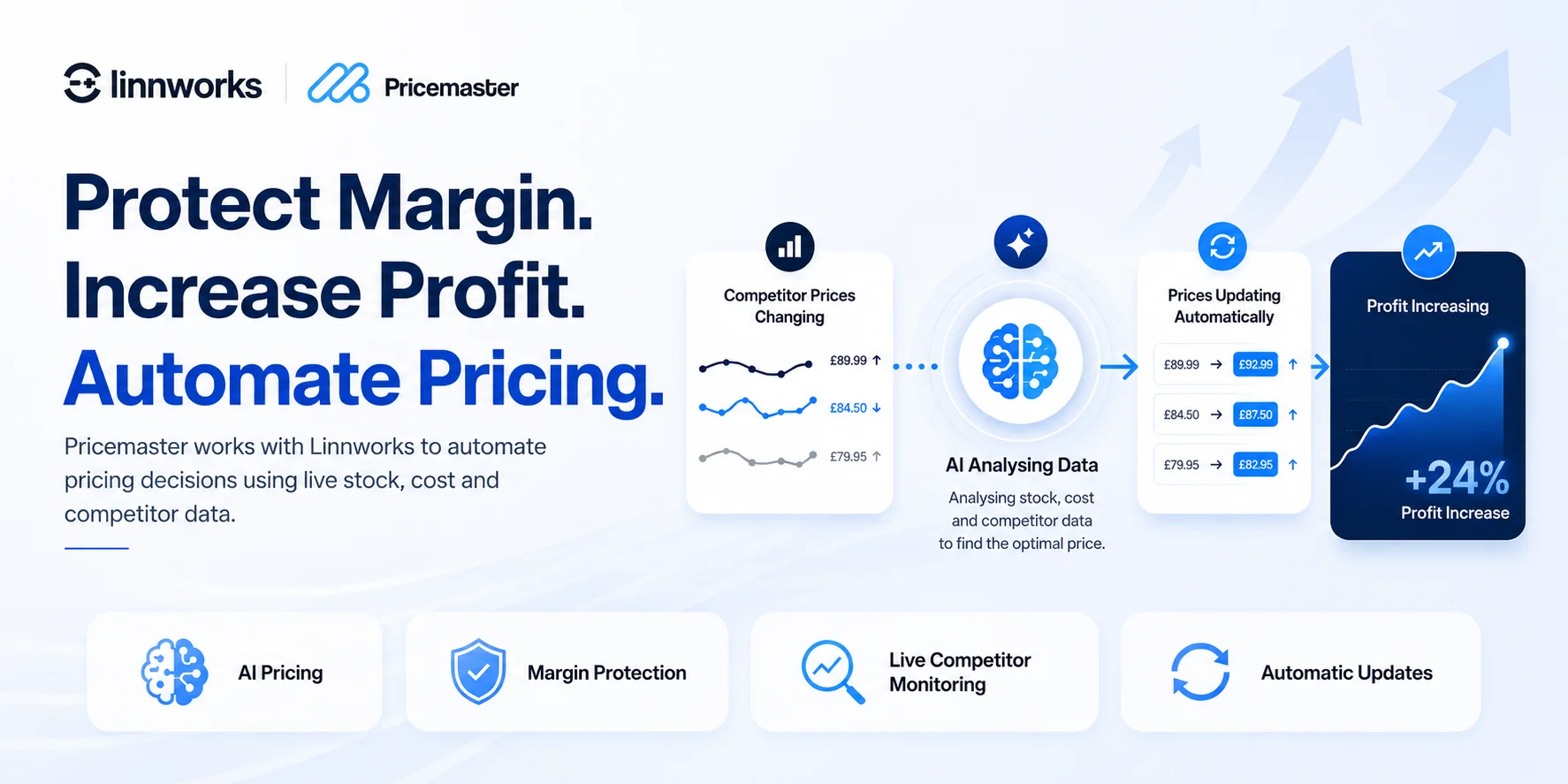
Revenue growth often starts by adding more cost.
Ecommerce plans commonly focus on acquiring more visitors, adding more products and reaching more channels. Those activities can grow revenue, but each usually requires further investment in media, people, technology or stock.
Pricing is different. It is a commercial lever applied to the traffic, orders and product demand the business already has. Better decisions can help retain more value from existing sales while still supporting competitiveness.
You do not always need more customers to improve profit. Sometimes you need stronger pricing decisions.
Revenue does not equal profit.
Two retailers with similar sales can produce very different commercial results. The difference is often found in the decisions made between acquiring the customer and completing the order.
Selling price and discounting
The amount retained from an order depends on where the product was positioned and whether a reduction was commercially necessary.
Product mix
Revenue concentrated in low-margin lines can produce a different result from the same turnover across a healthier mix.
Supplier costs
Cost changes need to reach pricing decisions quickly enough to prevent avoidable margin erosion.
Advertising efficiency
Paid demand creates more value when the promoted products are positioned to convert without giving away unnecessary margin.
Margin control
Commercial floors and exclusions keep automation aligned with the financial requirements of the business.
Stock position
Your availability and the competitor's availability can change what a sensible market response looks like.
One keeps products, inventory, orders and channels connected. The other helps decide how each product should be positioned within that operation.
Small decisions become commercially significant at catalogue scale.
A single price change may look minor. Repeated across thousands of products and orders, those decisions influence conversion, gross margin and the amount of value retained from every sale.
Priced too high
A weak market position may reduce conversion on products where shoppers can compare alternatives directly.
Priced too low
A product can sacrifice margin even when the market would support a stronger selling price.
Discount left behind
A reduction can remain in place after competitors and wider market prices have moved upwards.
Cost change missed
A supplier increase that is not reflected promptly can erode margin across every subsequent order.
Wrong competitor followed
Reacting to an out-of-stock or unsuitable seller can create an unnecessary price reduction.
Headroom overlooked
Some fast-selling, trusted or exclusive products may support a controlled increase without damaging demand.
Pricing is not about changing every price. It is about making the right decision for every product.
Being cheapest is not always the right strategy.
Customers consider more than the headline price. Stock availability, delivery speed, brand trust, service, reviews, returns, expertise and convenience can all influence which retailer wins the order.
Pricemaster supports the position selected by the retailer. It does not automatically force every product to the lowest visible price.
Relevant competition matters more than every competitor. A low price from an unsuitable or out-of-stock seller may not justify a response. Competitor monitoring provides the context required to make that distinction.
A good pricing system knows when to do nothing.
Automation should separate products that need action from products already in a commercially sensible position. It should also recognise when the available data or operating conditions make a change inappropriate.
Sometimes the most profitable pricing decision is no change at all.
Margin protection must sit beneath every rule.
Automation without a reliable commercial floor can turn speed into risk. Every proposed change should be tested against the cost, margin requirement, market situation and product strategy before it reaches a sales channel.
Margin policies can be applied at the appropriate level for the catalogue, including brand, category, cost band, product group and individual product. Learn more about minimum-margin protection.
Not every pricing opportunity means charging less.
Live market data can also reveal where a product may be giving away margin unnecessarily. These are opportunities for analysis rather than guaranteed financial outcomes.
Unnecessarily below market
Identify products where the current price sits below all relevant in-stock competition without a clear strategic reason.
No relevant competition
Recognise when the apparent lowest competitor cannot fulfil or should not influence the pricing rule.
Discounted for too long
Review products that remained reduced after the market conditions behind the decision changed.
Market moving upwards
Create an opportunity to follow relevant upward movement rather than reacting only when prices fall.
Own-brand and exclusives
Use internal demand evidence where direct product comparisons cannot provide a reliable benchmark.
Controlled testing
Measure whether eligible fast-selling products may support additional margin through carefully governed tests.
Use the right evidence for each type of product.
Branded, comparable products
Use competitor prices, availability and relevant market position to support the decision.
- Direct product comparisons
- Current competitor stock
- Selected market position
- Margin and exclusion rules
Own-brand and exclusive products
Use internal performance and controlled testing where a reliable external benchmark is unavailable.
- Sales performance and velocity
- Controlled price testing
- Demand and revenue response
- Product eligibility rules
AI supports the commercial team by finding patterns and measuring response; it does not claim to discover a universal “perfect price”. Explore sales-data-driven pricing.
Google Shopping efficiency and pricing are connected.
A product can attract paid traffic and still struggle to convert when its visible market position is weak. Pricing intelligence helps the team identify where acquisition spend and commercial positioning may be working against each other.
Find weak market positions
Identify promoted products whose visible price may be limiting the value of paid traffic.
Reduce avoidable waste
Give the team better evidence when deciding whether to continue promoting poorly positioned products.
Support product-page competitiveness
Align the landing-page price more closely with the market context shoppers can see.
Focus stronger opportunities
Help prioritise products with a healthier combination of demand, competitiveness and available margin.
Understand acquisition headroom
Identify where product margin may be better placed to absorb the cost of acquiring the order.
Support stronger ROAS decisions
Connect pricing position with campaign analysis instead of viewing media performance in isolation.
Stronger pricing intelligence can support advertising decisions and create opportunities to improve efficiency. It does not guarantee lower click costs, higher conversion or reduced media spend.
Pricing improvements compound.
The value comes from applying better-informed decisions consistently, not waiting for an occasional manual review of a small part of the catalogue.
Where Linnworks and Pricemaster fit together.
Linnworks connects the operational data and sales channels. Pricemaster adds the intelligence, rules and safeguards needed to turn that data into controlled pricing decisions.
Linnworks
- Products
- Inventory
- Orders
- Listings
- Fulfilment
- Connected sales channels
Pricemaster
- Market intelligence
- Competitor pricing
- Competitor stock
- Pricing rules
- Margin protection
- AI-supported optimisation
- Automated pricing decisions
Linnworks runs the operation. Pricemaster helps optimise the commercial return.
See how the complete Linnworks integration works.
For retailers ready to improve the value of every sale.
Commercial questions about automated pricing.
Does automated pricing mean lowering every price?
No. Pricemaster supports the commercial position selected by the retailer. A decision may be to reduce, increase or hold a price, depending on relevant competition, stock, cost, margin and strategy.
How does Pricemaster protect margin?
Proposed changes can be checked against current product cost and the required percentage or cash-margin floor before an approved price is returned through Linnworks.
Can Pricemaster identify opportunities to increase prices?
Yes. Market analysis can highlight products unnecessarily below relevant competition, products without in-stock competition and products where the wider market has moved upwards. These remain commercial opportunities rather than guaranteed outcomes.
How are own-brand products priced without direct competitors?
Eligible own-brand, exclusive and hard-to-compare products can use sales performance, velocity and controlled price testing to measure demand response within the rules selected by the retailer.
Does Pricemaster replace Linnworks?
No. Linnworks remains the operational platform. Pricemaster adds market intelligence, pricing rules, margin safeguards and automated pricing decisions around the connected Linnworks operation.