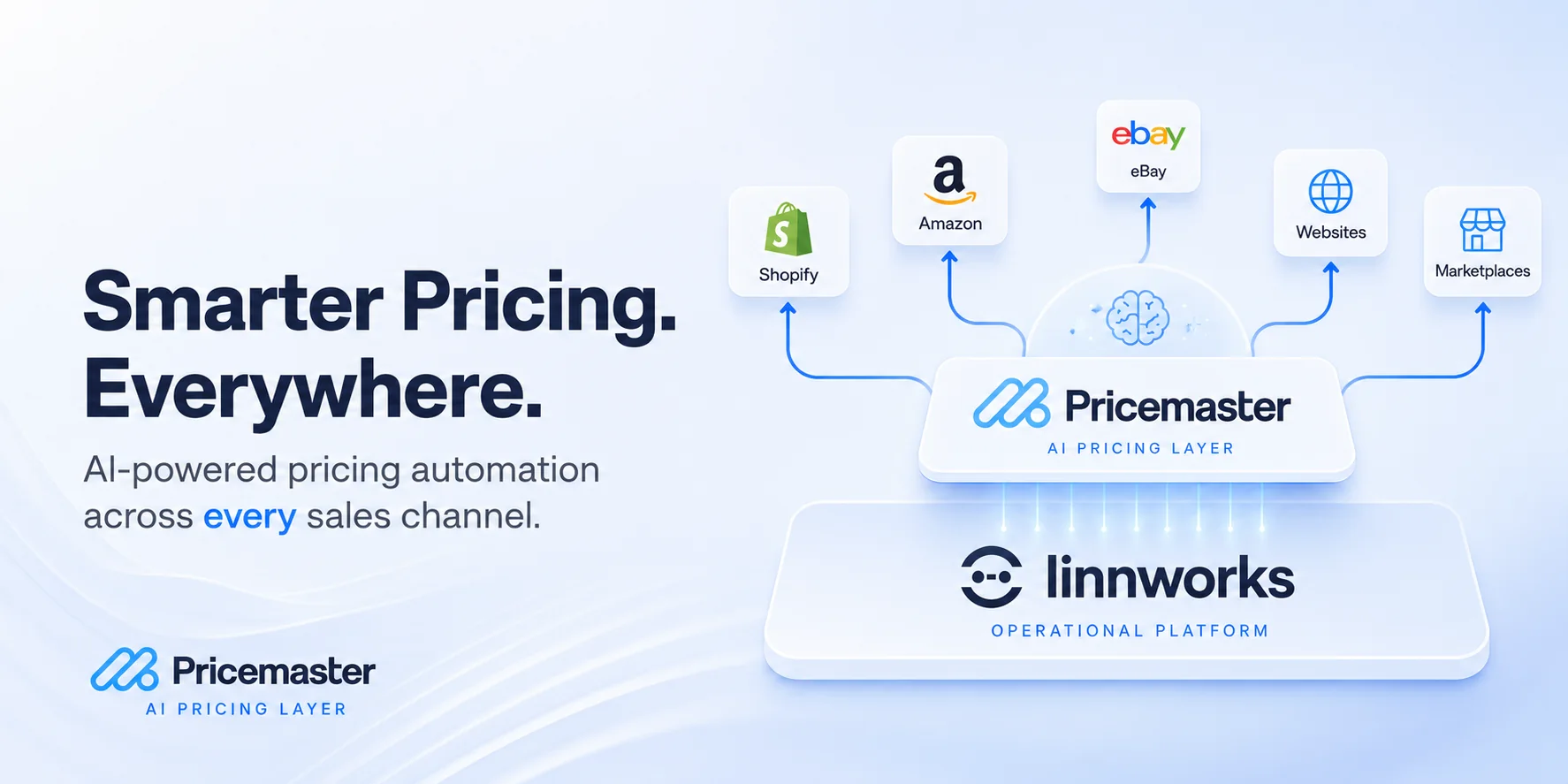
Your ecommerce operation is already connected.
Implementing Linnworks is often one of the most important operational improvements a multichannel retailer makes. It replaces fragmented processes with a central place to manage the work that keeps orders moving.
Inventory management
Keep stock positions visible and coordinated across the operation.
Order management
Bring orders from connected channels into one operational workflow.
Product management
Maintain the product information that supports listings and fulfilment.
Listings
Control how products are represented across connected destinations.
Marketplace integrations
Connect the channels where customers discover and buy products.
Fulfilment
Coordinate the work required to move each order from purchase to delivery.
Linnworks runs your operations. Pricemaster runs your pricing.
But pricing often gets left behind.
It is common to find a modern Linnworks operation sitting alongside a pricing process built from spreadsheets, browser tabs and individual knowledge. The operation is connected, but the commercial decision that shapes conversion and margin still depends on manual effort.
Spreadsheets
Pricing logic becomes difficult to govern as more products, channels and team members are added.
Browser tabs
Competitor checks provide a momentary view that can be out of date before updates are complete.
Manual checks
Repeated monitoring consumes commercial time without creating a scalable process.
Internal knowledge
Important exceptions and competitor context can remain undocumented and difficult to apply consistently.
Individual dependency
When one person owns the process, pricing slows down when their attention is needed elsewhere.
A marketplace manager may know which competitors matter. A buyer may know which brands can hold a stronger margin. An ecommerce manager may know which products are hurting Google Shopping performance. When that knowledge lives with individuals instead of a system, it is difficult to apply consistently across every SKU and channel.
Pricing deserves the same level of automation as inventory.
Retailers would not manage stock availability for thousands of products in an ungoverned spreadsheet. Pricing should be treated with the same discipline.
That means one pricing process that can react to current product, cost, stock and market data while applying the commercial rules selected by your team.
Add the intelligent pricing layer to Linnworks.
Pricemaster extends the operation you already have. Linnworks remains the operational platform; Pricemaster turns connected data into controlled pricing decisions and returns approved updates to every sales channel.
See the complete Linnworks integration and how data moves between the two platforms.
Every capability should lead to a better commercial decision.
This is not a list of disconnected features. Each part of Pricemaster exists to help the retailer respond with more context, consistency and control.
Complete market monitoring
Replace fragmented checks with a current product-level view of competitors, prices and availability.
Explore market monitoringCompetitor stock context
Avoid reacting blindly to a low price from a seller that cannot currently fulfil the order.
Rule-based automation
Turn the team's commercial approach into repeatable decisions across brands, categories and product groups.
Explore automated pricingMinimum-margin protection
Check every proposed price against current cost and required percentage or cash-margin floors.
Explore margin protectionAI pricing optimisation
Use controlled sales analysis to find opportunities where a reliable external benchmark is unavailable.
Explore AI pricingOwn-brand pricing
Apply measured price testing to exclusive and own-brand ranges instead of leaving prices static.
Google Shopping efficiency
Identify products that may be losing valuable clicks because their visible price is out of step with the market.
Conversion support
Use stronger market positioning to give more shoppers a reason to complete the purchase, without guaranteeing outcomes.
Pricing consistency
Apply one governed commercial strategy across the channels already connected through Linnworks.
Clear reporting
Give commercial teams visibility into the rules, inputs and reasoning behind pricing changes.
Extend what already works. Do not replace it.
Teams continue using Linnworks exactly as they do today. There is no replacement project and no second operational workflow to maintain. Pricemaster uses the connected product, stock and cost context to make the existing operation commercially smarter.
More confidence, consistency and market visibility.
Retailers usually invest in pricing automation because they want the process to become more manageable and commercially dependable as the business grows.
Less manual work
Move the team away from repeated checking and product-by-product updates.
Faster market reaction
Respond to relevant price and availability changes without waiting for the next spreadsheet cycle.
Better consistency
Apply the same approved logic across the catalogue and connected channels.
Stronger margin control
Keep cost and margin safeguards inside every automated decision.
Greater pricing confidence
Base decisions on visible market context rather than isolated checks or assumptions.
Improved visibility
Understand where products sit in the market and which areas require commercial attention.
These are potential operational and commercial improvements rather than guaranteed results. Outcomes depend on the retailer’s catalogue, market, strategy and implementation.
For Linnworks retailers ready to modernise the pricing process.
What Linnworks teams usually want to know.
Does Pricemaster replace Linnworks?
No. Linnworks remains the operational platform for products, inventory, orders, listings and fulfilment. Pricemaster adds the pricing intelligence and automation layer.
Will our team need a second operational workflow?
No. Pricemaster is designed to extend the Linnworks setup you already use. Product, stock and cost context supports pricing decisions, and approved prices return through Linnworks.
Can we keep control over pricing strategy?
Yes. Your team defines the competitors, market position, product groups, exclusions and margin safeguards. Automation executes that approved strategy consistently.
Can Pricemaster support own-brand products?
Yes. For own-brand, exclusive or poorly benchmarked products, controlled sales-data analysis can help identify potential pricing and margin opportunities.
What happens to our existing Linnworks integrations?
They remain in place. Pricemaster uses Linnworks as the operational connection point so pricing can extend across the channels you already manage.