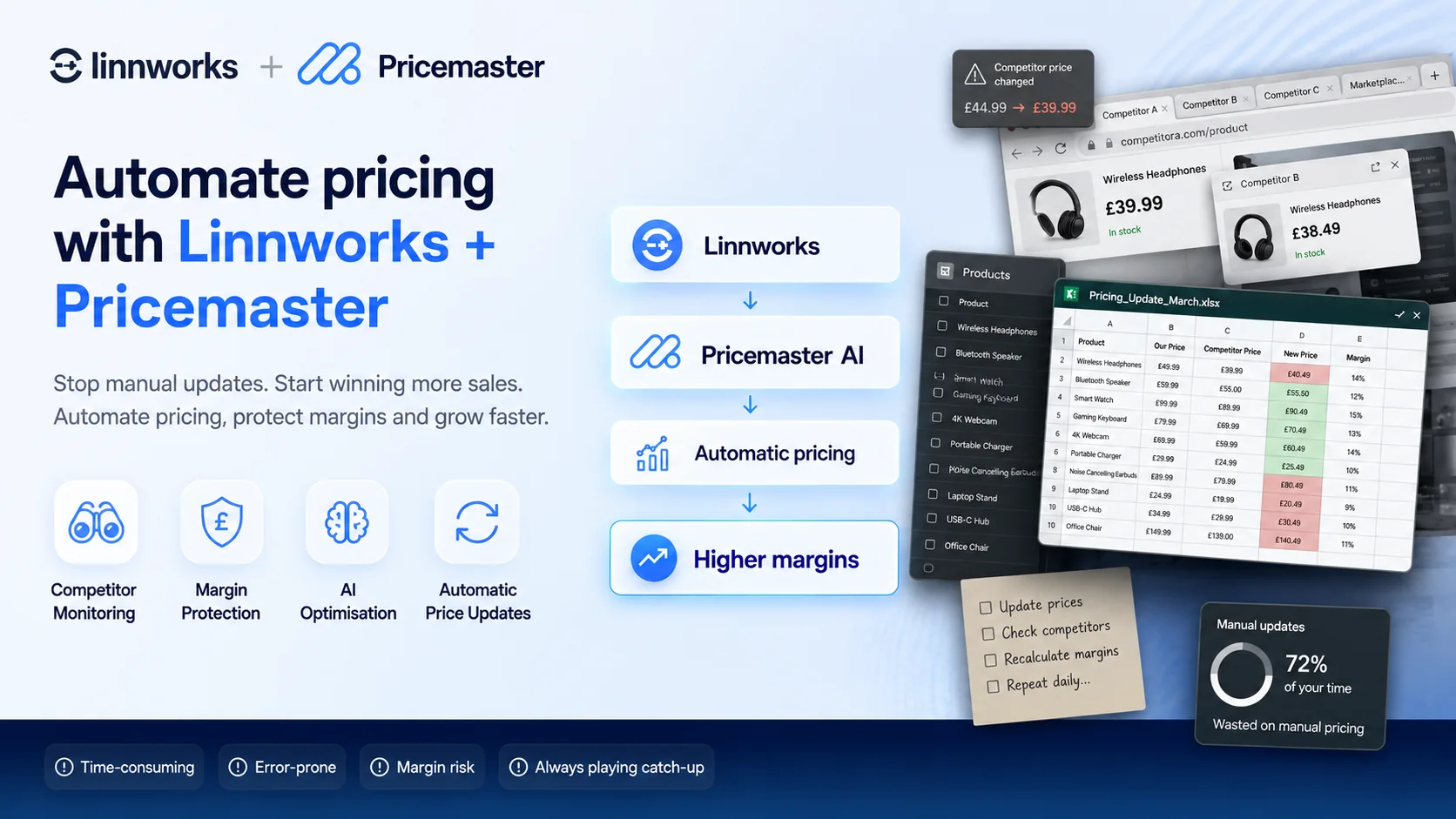
Manual pricing creates commercial drag.
Checking websites and maintaining spreadsheets is not just slow. It separates pricing from the live information needed to make a safe, profitable decision.
Slow market response
By the time checks are complete and spreadsheets are approved, competitors may already have moved again.
Margin leakage
Teams can discount when they do not need to, or miss supplier cost movements that change the safe selling price.
Incomplete decisions
A low competitor price means little if that seller has no stock and cannot fulfil the order.
Inconsistent channels
Disconnected updates make it harder to apply one commercial strategy across every connected sales channel.
The workload grows faster than the team.
Every expansion adds another layer of checks, exceptions and updates. Hiring more people may increase capacity, but it does not solve the underlying process problem: pricing still depends on disconnected information and repeated manual decisions.
Linnworks has already centralised the operation.
Linnworks brings the operational parts of multichannel retail together. Products, inventory, orders, listings and fulfilment can be managed from one connected environment instead of a collection of isolated systems.
Your operational data is already centralised. Your pricing decisions should be too.
Introducing the Pricemaster pricing layer.
Pricemaster works alongside Linnworks. It combines operational data with live market intelligence, applies your pricing strategy and returns approved prices through the same connected operation.
This creates a closed loop: Linnworks runs the operation; Pricemaster runs the pricing. Explore the full Linnworks integration to see how the two platforms connect.
Price is only useful when you understand the market around it.
Pricemaster continuously gathers and analyses the signals needed to judge where each product sits and what a commercially sensible response looks like.
- Competitor prices
- Competitor stock availability
- Market position
- Price movements
- Product-level opportunities
- Relevant competitor behaviour
A retailer should not automatically follow the lowest price when that competitor cannot fulfil the order. Availability provides essential context for a pricing rule.
Explore market monitoringYour team defines the commercial strategy.
This is not uncontrolled repricing or a race to the bottom. Pricemaster executes the position, competitors, product groups and safeguards selected by your team.
Match the lowest in-stock competitor
Remain second cheapest
Stay above or below selected competitors
Ignore unsuitable competitors
Apply rules by brand, category or group
Enforce a minimum margin
Lock selected products
Use fallback rules when data is unavailable
See how these controls work across automated ecommerce pricing.
Every decision passes through the commercial guardrails.
A competitive price still needs to be a viable price. Pricemaster can consider the complete decision context before any update is returned through Linnworks.
Better pricing can make marketing work harder.
When products are competitively positioned without unnecessary discounting, pricing can support the wider ecommerce and acquisition strategy.
Product-page conversion
Competitive prices can give more shoppers a reason to complete the purchase.
Google Shopping efficiency
A stronger market position can reduce wasted clicks on products that are visibly uncompetitive.
Return on advertising spend
Better alignment between traffic cost, selling price and margin can support more efficient campaigns.
Margin opportunities
Market and sales data can highlight products where the current price may be lower than necessary.
These are potential commercial outcomes, not guarantees. Results depend on the retailer’s market, catalogue, traffic, commercial strategy and implementation.
Not every product has a clean competitor benchmark.
Use real sales response for own-brand and exclusive ranges.
For products that are unique, exclusive or poorly benchmarked, Pricemaster can analyse sales performance and run controlled pricing tests. Small changes are measured against demand so the team can identify opportunities to improve margin without relying on vague AI predictions or uncontrolled price moves.
Explore sales-data-driven pricingFrom repeated manual tasks to one controlled pricing system.
- Spreadsheets
- Browser tabs
- Manual competitor checks
- Slow price updates
- Inconsistent rules
- Margin leakage
- Limited market visibility
- Centralised market intelligence
- Automated pricing rules
- Margin protection
- Competitor stock awareness
- Faster market response
- Consistent multichannel pricing
- Clear reporting and control
Built for retailers where pricing has become an operational workload.
Practical answers before you connect.
Does Pricemaster replace Linnworks?
No. Linnworks continues to manage the operational workflow, while Pricemaster adds market intelligence, pricing rules and margin-aware automation. The platforms are complementary.
Can Pricemaster use competitor stock information?
Yes. Competitor availability can be considered alongside price, helping retailers avoid following a low price from a seller that cannot fulfil the order.
Does automated pricing mean always being cheapest?
No. Retailers define the strategy. Rules can target different market positions, selected competitors, brands, categories and margin floors without creating a race to the bottom.
Can selected products stay outside automation?
Yes. Products can be locked or excluded where a team wants to retain manual control or apply a different commercial process.
Can Pricemaster help with own-brand products?
Yes. Where direct competitor benchmarks are weak or unavailable, sales performance and controlled price testing can be used to identify potential margin opportunities.